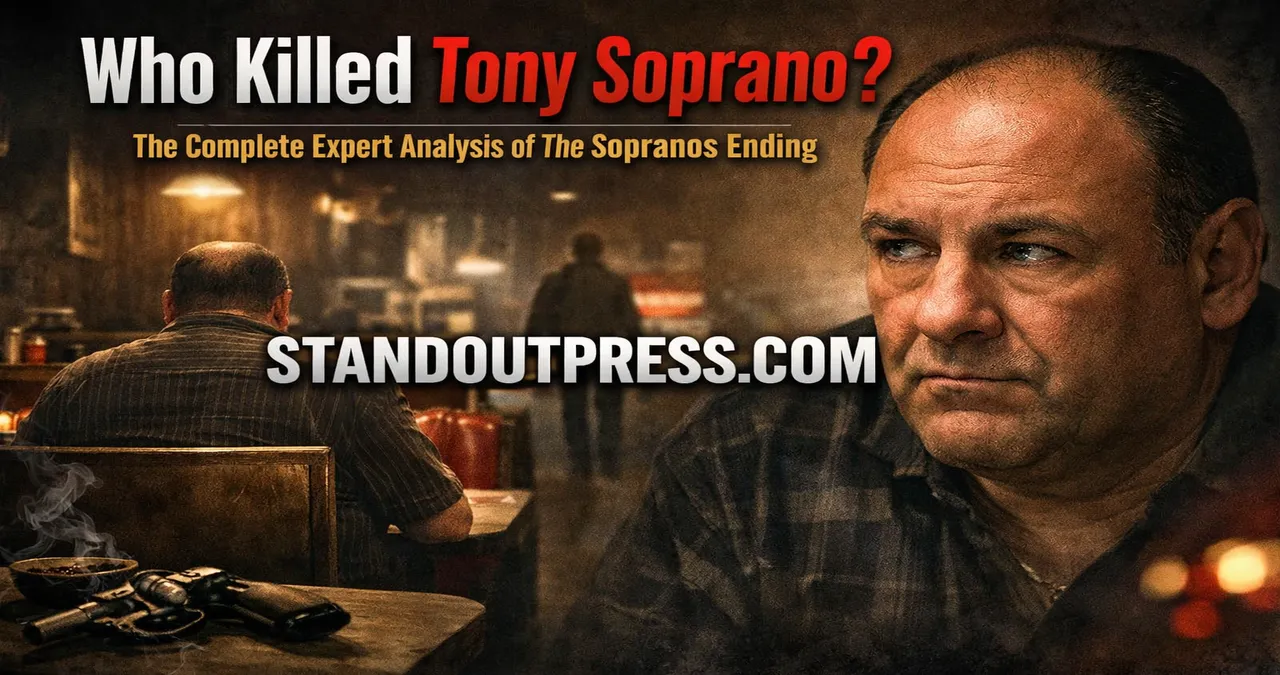
Who killed Tony Soprano? Explore the most detailed expert breakdown of The Sopranos ending, hidden clues, popular theories, symbolism, and what really happened in the final scene.
The question of who killed Tony Soprano has lingered in popular culture like an unresolved chord, vibrating through television criticism, fan debates, and academic essays for years. Few finales in modern storytelling have inspired this level of obsession, reinterpretation, and emotional response. The moment the screen cuts to black, viewers are left suspended between certainty and doubt, forced to confront not only the fate of a fictional mob boss but also their own expectations about storytelling, justice, and closure.
What makes the mystery of who killed Tony Soprano so compelling is that it refuses to settle into a single, comfortable answer. The series never hands the audience a neat explanation. Instead, it offers fragments, patterns, and clues that reward close attention and punish passive viewing. The ambiguity is deliberate, layered, and deeply connected to the themes that run through the entire show. To understand the ending, and to seriously engage with the question of who killed Tony Soprano, you have to understand the world Tony lived in, the choices he made, and the philosophy behind the story itself.
Understanding the Cultural Weight of Tony Soprano
Tony Soprano is not just another television character. He is a cultural symbol, a contradiction in human form, and a lens through which viewers examine power, morality, and self delusion. Any serious discussion about who killed Tony Soprano has to start with who Tony was and what he represented.
From the very beginning, Tony exists in two worlds. He is a family man plagued by panic attacks and emotional confusion, and he is a ruthless crime boss capable of extreme violence. The show constantly forces the audience to sit with this discomfort. We empathize with Tony even as we watch him destroy lives. That emotional investment makes the question of who killed Tony Soprano feel personal, almost intimate, rather than purely analytical.
Culturally, Tony arrived at a moment when television was shifting toward morally complex protagonists. He opened the door for countless characters who followed, but none have quite matched his impact. Because of that, his ending carried enormous expectations. Viewers did not just want to know what happened; they wanted it to mean something. The unresolved nature of who killed Tony Soprano challenged the idea that every story owes its audience a clear moral accounting.
The Final Scene and Why It Matters
The final scene of the series is one of the most dissected moments in television history. On the surface, it is deceptively simple. Tony sits in a diner with his family, ordinary music plays, and everyday life unfolds. Beneath that calm exterior, however, the tension is unbearable. Every movement, every glance, every sound feels loaded with meaning. This is the crucible in which the debate over who killed Tony Soprano truly begins.
What makes this scene so effective is its pacing and restraint. There is no dramatic confrontation, no explicit threat, no visible violence. Instead, the show invites the audience to experience the paranoia that defined Tony’s life. For years, he lived knowing that death could come at any moment. In the diner, that feeling is shared with the viewer. The sudden cut to black is not just a technical choice; it is an experiential one. It places the audience inside Tony’s perspective, forcing them to confront the possibility of his death without the comfort of confirmation.
The absence of an answer is not a mistake or a trick. It is the point. The question of who killed Tony Soprano becomes a mirror, reflecting the viewer’s own assumptions and desires. Some see death as inevitable. Others see survival as equally plausible. The scene works because it allows both interpretations to coexist.
Creator Intent and Narrative Philosophy
To understand who killed Tony Soprano, it is essential to consider the mindset of the show’s creator and the broader narrative philosophy guiding the series. The show consistently resists easy answers, preferring psychological realism over dramatic payoff. Violence is sudden and often unceremonious. Consequences are messy and unresolved. This storytelling approach informs the ending more than any single clue or theory.
The creator has spoken indirectly about the ending, emphasizing that the show was never about spectacle. It was about character, mood, and the quiet dread of living a life built on betrayal. In that context, the debate over who killed Tony Soprano may be less important than the emotional truth of the moment. Whether Tony lives or dies, he is trapped in a cycle of fear, suspicion, and moral decay.
This perspective reframes the ending as a thematic conclusion rather than a plot conclusion. The lack of certainty is not an omission but a statement. Life, especially a life like Tony’s, does not always provide closure. The audience is left in the same position as Tony himself, always waiting for the knock on the door or the stranger at the counter.
The Argument That Tony Was Killed
One of the most popular interpretations is that Tony dies in the diner. Supporters of this view argue that the show provides subtle but deliberate clues pointing toward his death. From this perspective, the question of who killed Tony Soprano has an answer, even if it is not shown explicitly.
Advocates of this theory point to patterns established earlier in the series. Characters are often killed suddenly, without warning or dramatic buildup. Death arrives mid sentence, mid thought, mid life. The abrupt cut to black mirrors these moments, suggesting that the audience experiences Tony’s death exactly as he does. There is no fade out, no music cue, no final reflection. There is only nothing.
This interpretation also draws on visual language. The focus on Tony’s point of view, the repeated shots of the diner entrance, and the presence of a suspicious stranger all contribute to a sense of impending violence. For those who accept this reading, the mystery of who killed Tony Soprano becomes a matter of identifying the likely culprit rather than questioning whether a killing occurred at all.
The Members Only Jacket Theory
Among the many theories about who killed Tony Soprano, one stands out for its detailed attention to visual cues. The so called members only jacket theory centers on a man sitting in the diner who wears a distinctive jacket and repeatedly glances toward Tony. This character eventually walks toward the restroom, passing behind Tony in a way that echoes a famous scene from classic crime cinema.
Supporters of this theory argue that the show intentionally draws this parallel to signal Tony’s impending death. In the referenced film, a hitman emerges from a restroom to kill his target from behind. By recreating this setup, the series invites viewers to connect the dots. The cut to black occurs just as the man would be in position, implying that the fatal shot has been fired.
What makes this theory compelling is its subtlety. The show never draws attention to the man explicitly. There is no ominous music or exaggerated framing. Instead, the clues are there for those who are paying close attention. For many fans, this level of detail supports the idea that who killed Tony Soprano is answered through implication rather than exposition.
The Case Against a Definitive Death
Despite the popularity of the death interpretation, there is a strong argument that Tony does not die in the final scene. From this perspective, the question of who killed Tony Soprano remains intentionally unanswered, and that ambiguity is the true ending.
Proponents of this view argue that the series repeatedly shows Tony surviving situations that seem far more dangerous than a family dinner. He lives in constant threat, yet life continues. The final scene may simply represent another moment of anxiety in a long line of anxious moments. The cut to black could signify the end of the story, not the end of Tony’s life.
This interpretation emphasizes the idea that the show is not obligated to resolve every narrative thread. By refusing to confirm Tony’s death, the series stays true to its commitment to realism. In real life, people do not receive narrative closure. They simply stop being observed. In this sense, the mystery of who killed Tony Soprano is less a puzzle to be solved and more a philosophical statement about storytelling itself.
Symbolism and Existential Themes
The debate over who killed Tony Soprano cannot be separated from the show’s deep engagement with existential themes. Throughout the series, Tony struggles with the meaning of his life, the inevitability of death, and the emptiness of his pursuits. Therapy sessions, dream sequences, and casual conversations all circle around these questions.
The final scene functions as a culmination of these themes. Tony is alive, but he is not free. He sits with his family, yet he is isolated by his own paranoia. The world continues around him, indifferent to his inner turmoil. Whether he dies in that moment or not, his life has reached a kind of existential dead end.
From this angle, asking who killed Tony Soprano might miss the point. The show suggests that Tony has been spiritually dead for a long time. His inability to change, to take responsibility, or to find genuine meaning has already sealed his fate. The ambiguity of the ending reflects the ambiguity of his existence.
Law Enforcement and Legal Consequences
Another angle in the discussion of who killed Tony Soprano involves the threat of legal consequences rather than physical violence. Throughout the series, law enforcement closes in on Tony’s operations. Informants flip, evidence accumulates, and the walls steadily tighten.
Some viewers interpret the ending as a moment before arrest rather than assassination. The tension in the diner could stem from Tony’s awareness that his freedom is fragile. The cut to black might represent the end of his life as he knows it, not necessarily his physical death. Prison, in this reading, is a different kind of ending, one that aligns with the show’s interest in psychological punishment over dramatic spectacle.
This interpretation broadens the question of who killed Tony Soprano to include institutions and systems rather than individuals. Tony’s choices, combined with relentless legal pressure, may have doomed him just as surely as any bullet.
Family as Both Shield and Vulnerability
Tony’s family has always been both his refuge and his greatest weakness. In considering who killed Tony Soprano, it is impossible to ignore the role his loved ones play in the final scene. The diner is not a neutral location. It is a family space, a symbol of normalcy that Tony has always tried and failed to maintain.
The presence of his family heightens the stakes. If Tony is killed, it happens in front of the people he claims to protect. If he lives, he remains trapped in a cycle that endangers them all. The show forces the audience to confront the cost of Tony’s lifestyle not in abstract terms, but in intimate, human ones.
This dynamic reinforces the tragedy at the heart of the story. Tony’s desire to provide for his family is inseparable from the violence that threatens them. The unresolved nature of who killed Tony Soprano mirrors the unresolved tension between love and destruction that defines his life.
Audience Participation and Interpretive Freedom
One of the most radical aspects of the ending is how it transforms the audience into active participants. The question of who killed Tony Soprano is not answered because the show wants viewers to wrestle with it themselves. Every interpretation reveals something about the person holding it.
Some viewers crave justice and see death as the appropriate consequence for Tony’s actions. Others focus on realism and reject the idea of a tidy ending. Still others find meaning in the ambiguity itself, viewing it as a reflection of life’s unpredictability. The show accommodates all these perspectives without endorsing any single one.
This interpretive freedom is a hallmark of mature storytelling. By refusing to dictate meaning, the series respects its audience’s intelligence and emotional investment. The enduring debate over who killed Tony Soprano is proof that this approach succeeded.
Popular Theories at a Glance
Below is a simplified comparison of common interpretations surrounding who killed Tony Soprano, presented in a clear and accessible way.
| Interpretation | Core Idea | Why It Persists |
|---|---|---|
| Assassination | Tony is killed in the diner | Visual clues and narrative patterns |
| Survival | Tony lives beyond the final scene | Commitment to realism and ambiguity |
| Arrest | Tony’s life ends legally, not violently | Ongoing legal pressure themes |
| Symbolic Death | Tony is spiritually or morally dead | Existential focus of the series |
Each theory adds depth to the discussion and highlights different aspects of the show’s themes and storytelling style.
Why the Mystery Endures
The lasting fascination with who killed Tony Soprano speaks to the power of the series as a whole. The ending did not fade from memory because it refused to satisfy conventional expectations. Instead, it invited endless reinterpretation, keeping the story alive long after it ended.
This endurance is also tied to the show’s honesty. It never pretended that life offers clear resolutions. By ending on uncertainty, the series remained true to its core values. The audience may argue, analyze, and speculate, but the story itself stands firm in its refusal to provide easy answers.
In a media landscape often dominated by over explanation, this restraint feels bold. The question of who killed Tony Soprano continues to matter because it is not just about a plot point. It is about how we understand stories, morality, and our own need for closure.
FAQs About Who Killed Tony Soprano
Did the show confirm who killed Tony Soprano
The show never explicitly confirms who killed Tony Soprano. The ending is intentionally ambiguous, allowing multiple interpretations to coexist without declaring one as definitive.
Is Tony Soprano definitely dead at the end
There is no definitive confirmation of Tony’s death. Many viewers believe he was killed, while others argue that the scene simply represents ongoing tension rather than a fatal moment.
Why did the show end so abruptly
The abrupt ending reflects the show’s commitment to realism and perspective. It places the audience in Tony’s experience, where life can end or continue without warning or explanation.
What does the ending say about Tony’s character
The ending emphasizes Tony’s constant state of fear and moral stagnation. Whether alive or dead, he remains trapped by his choices and unable to escape the consequences of his life.
Why is who killed Tony Soprano still debated
The debate persists because the show provides clues without conclusions. This invites viewers to engage deeply with the material and form their own interpretations based on themes and details.
Conclusion
The enduring question of who killed Tony Soprano is less about identifying a single answer and more about understanding the story’s deeper intentions. The ambiguity is not a flaw but a feature, one that challenges viewers to think critically about narrative, morality, and the nature of endings. In refusing to resolve Tony’s fate, the series achieved something rare: a finale that continues to live, provoke, and inspire long after the screen fades to black.